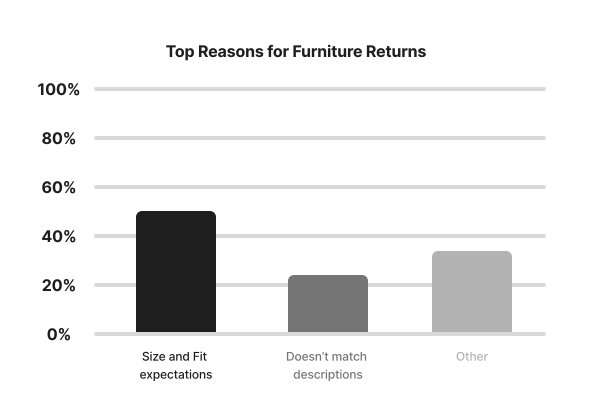
Three out of five product returns are due to customers misunderstanding size and scale, especially with custom items like sofas, beds, and large furniture, which are harder to visualize. This increases the chance that products don’t meet expectations. Returns make up about 28% of online sales, creating a heavy operational and financial burden for West Elm.

Double Dare Project
Overview
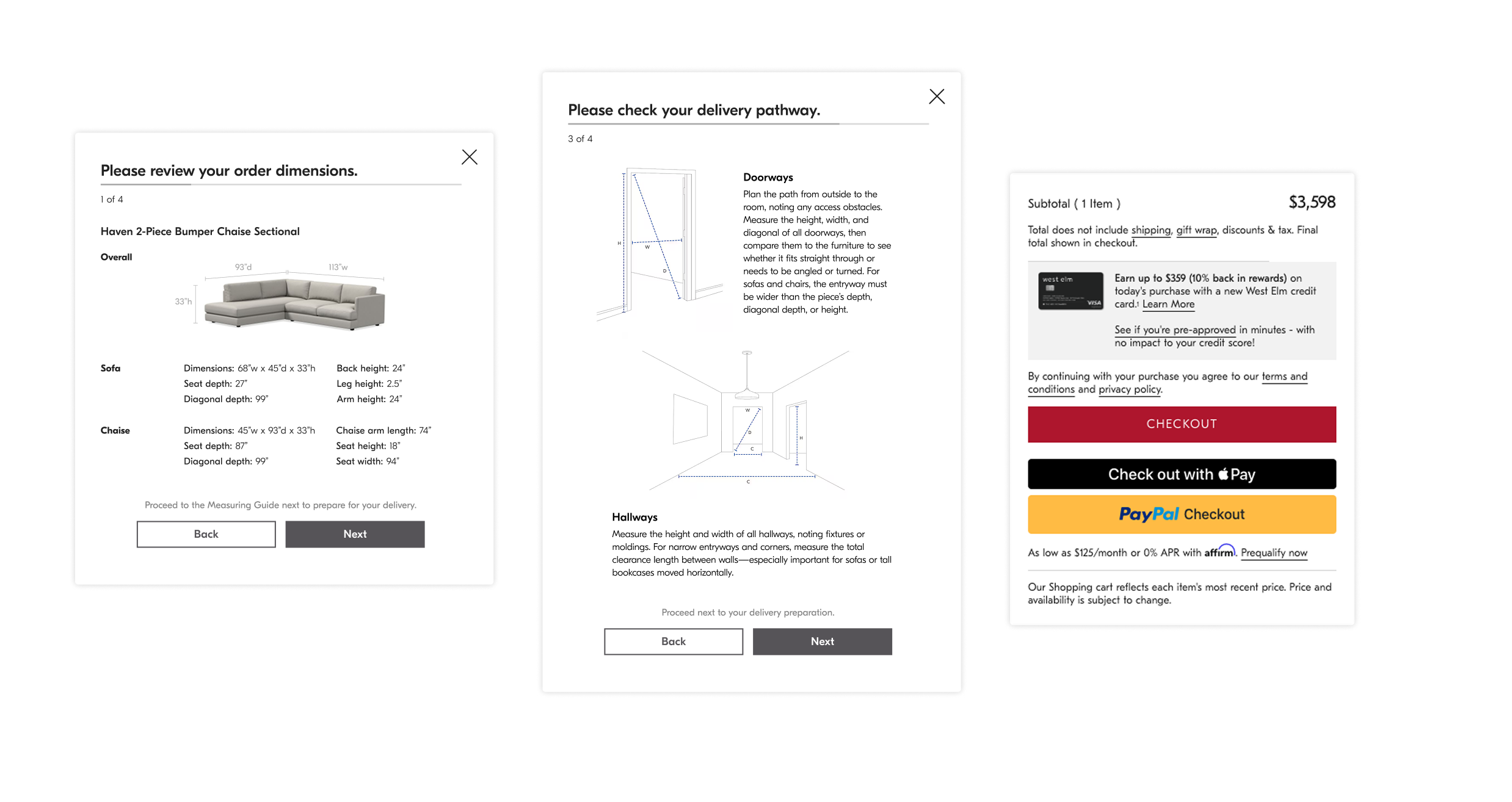
I led the design efforts for West Elm's "Double Dare" project, aiming to reduce customer returns of custom-made products and enhance customer confidence and satisfaction. This challenge has had a considerable impact on West Elm's annual profit margin.
The work included audits, qualitative and quantitative research, sketching, prototyping, usability testing, and ongoing pitches to cross-functional executive leadership.
TEAM
Phil Sison - Lead Product Designer
Chao Feng - Product Manager
John - Lead Engineer
Lou Escobar - UX Director
PROBLEM
Statement
West Elm has seen a rise in merchandise returns, especially for custom-made items. Customers are increasingly facing unforeseen delivery issues, such as furniture not fitting through doors or discrepancies in expected sizes. While this causes frustration for customers, it has also had a considerable impact on West Elm’s annual revenue and profit margin, driven by the volume of returns the company receives.
The current percentage of returns due to missing or unclear information when ordering custom-made items is around 20%. Reducing this by 4% would be considered a success.
DISCOVERY
Analytics
Research Data
Interviews and Feedback
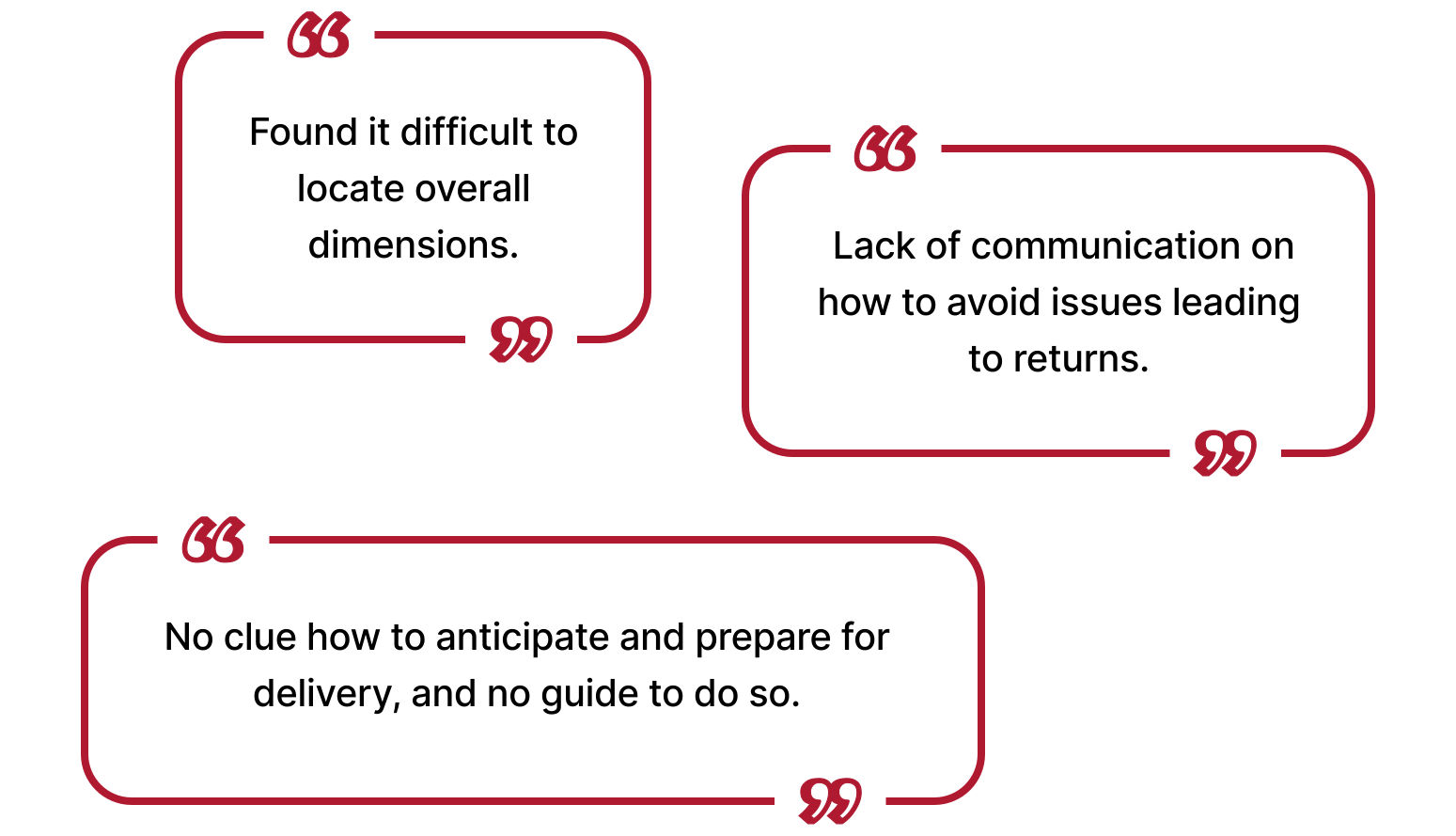
Customer interviews and feedback, collected regarding the reasons for their returns, collectively highlight a deficiency in communication and guidance throughout the process, from product discovery to the purchase experience.
Audit Validation
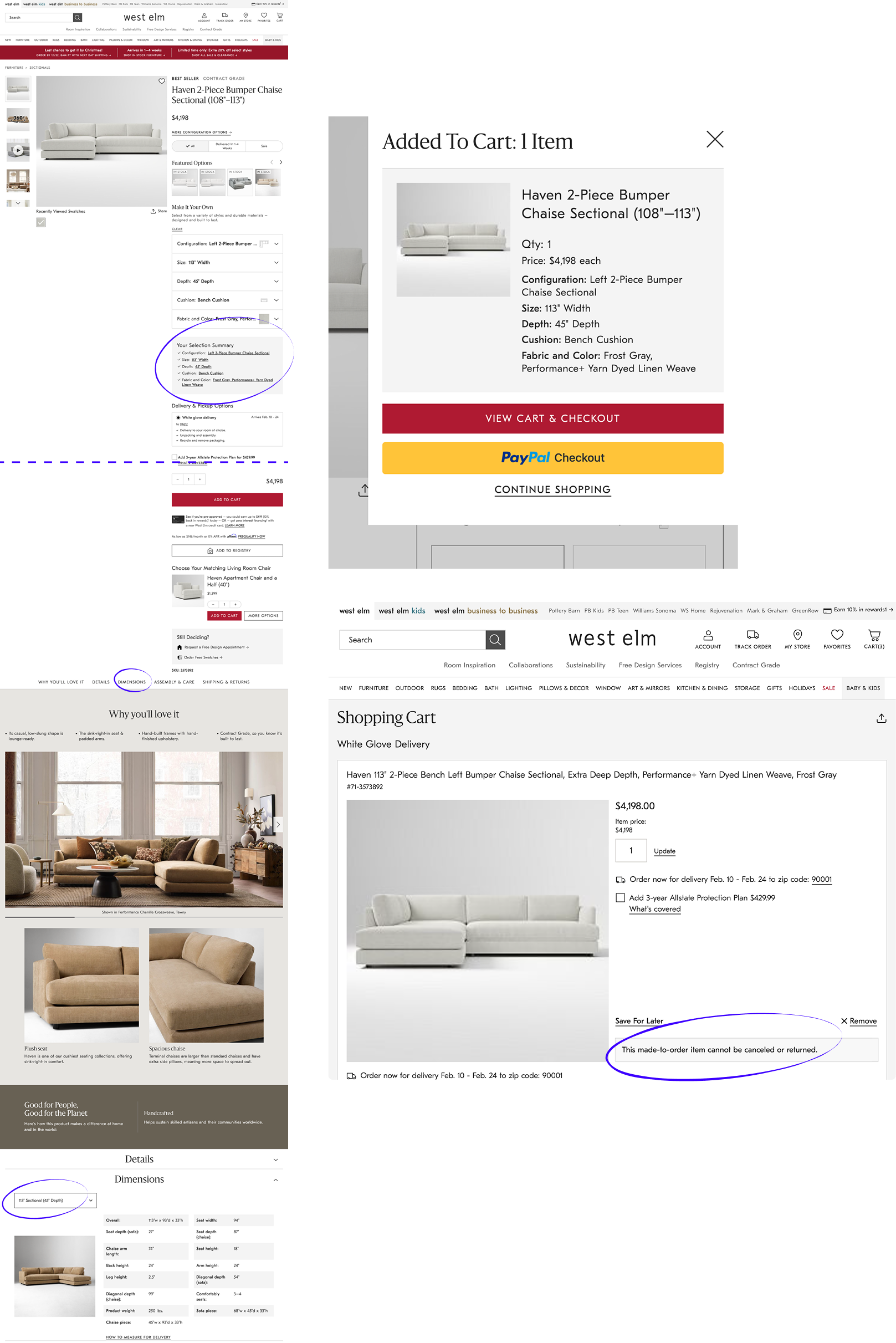
I’ve reviewed the process of ordering a custom-made item to verify customer concerns and identify friction points and opportunities to resolve information gaps.
Product Detail Page
- Absence of messaging regarding custom orders and No Returns policies to encourage careful verification of orders.
- The dimensions provided in the Selection Summary are limited.
- The detailed dimension information is far below the fold and hard to find.
- The dimensions area shows all available order options and does not automatically update based on your selection.
Order Confirmation
Lack of reminder about custom orders and No Returns policies to encourage careful verification of orders.
Shopping Cart
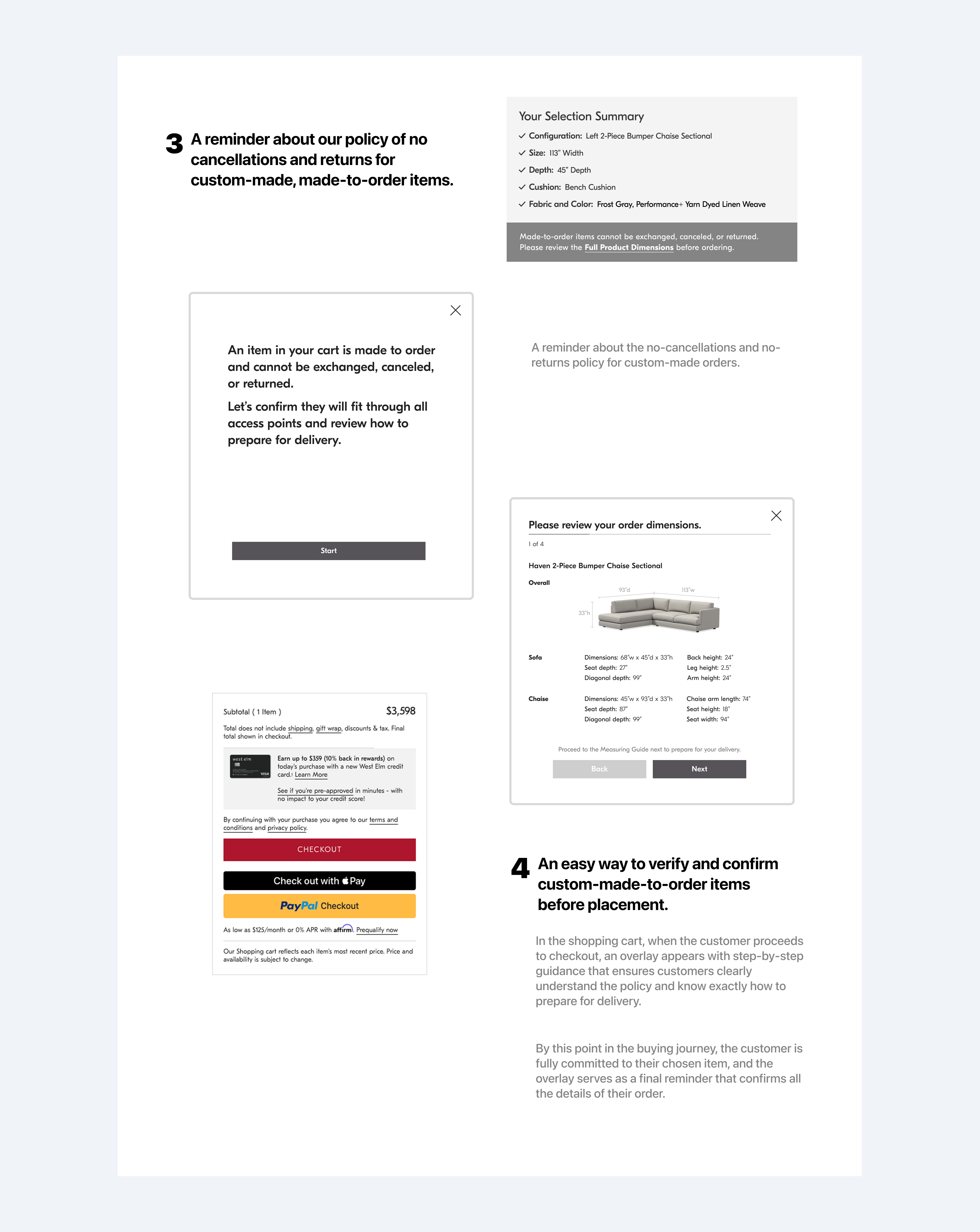
A reminder about custom orders and No Returns policies is displayed to encourage careful verification of orders before placement, but it serves no guidance on how to avoid this.
EXPERIENCE MAP
Friction and Opportunities
Putting together an experience map helped me communicate the big picture to stakeholders and leadership and support decisions about what to focus on, based on our research and insights.
The experience map depicts the customer’s path from product discovery and evaluation through the order process and purchase. The map also visualizes stages, a timeline, and emotions, showing the overall customer experience.
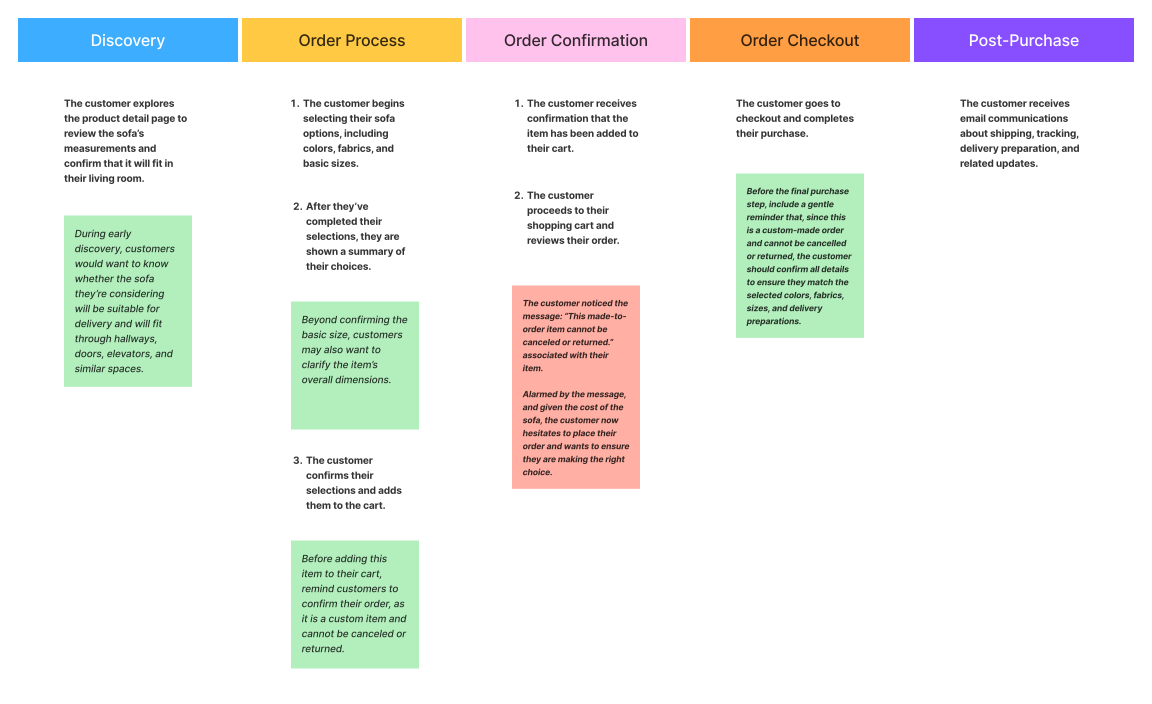
The map helps us see the entire customer’s path and immediately identify gaps in the user flow—the pain points and opportunities the design team will need to resolve to create a solution that improves the customer buying experience.
APPROACH
The smallest experience that proves value and enables learning
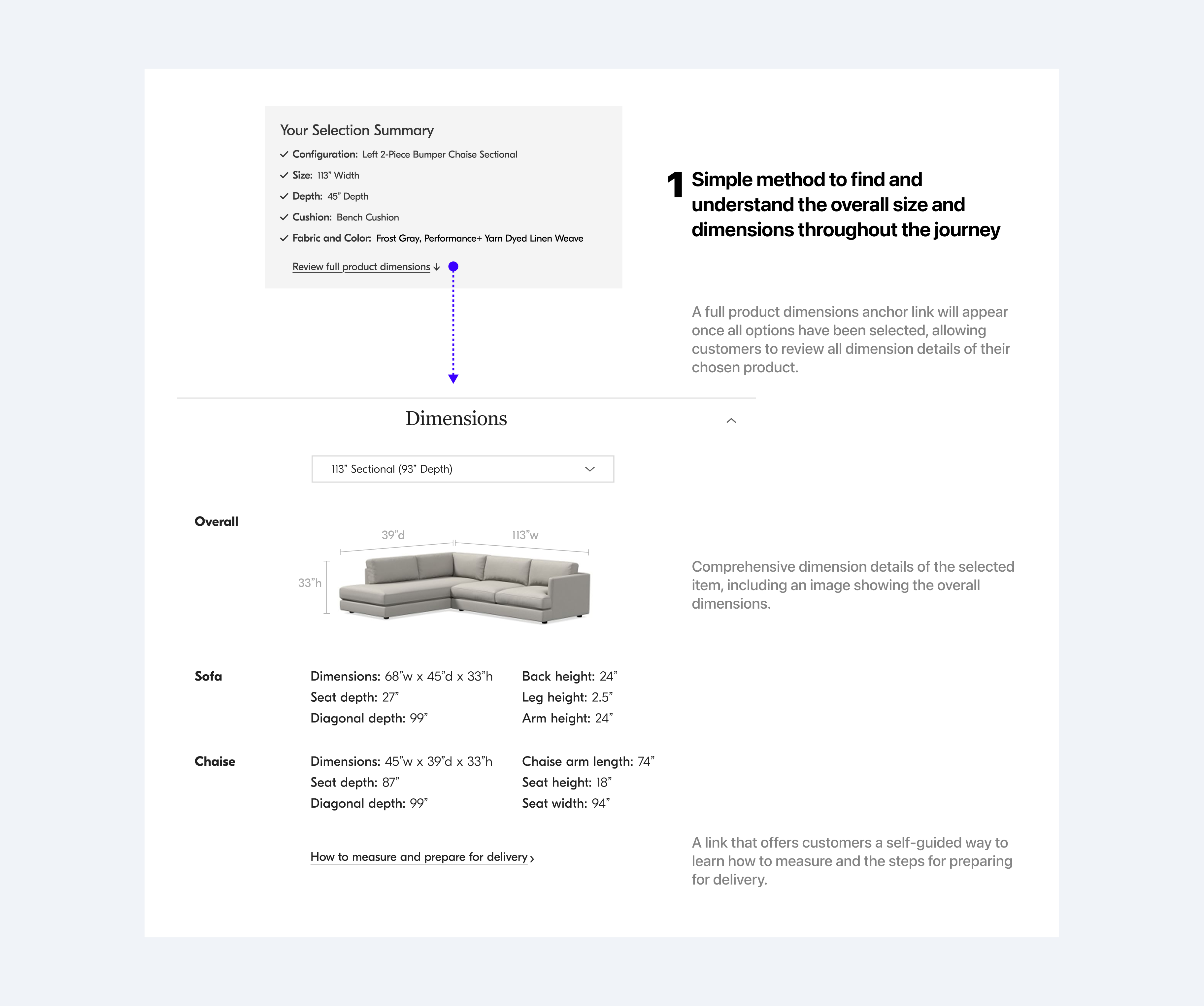
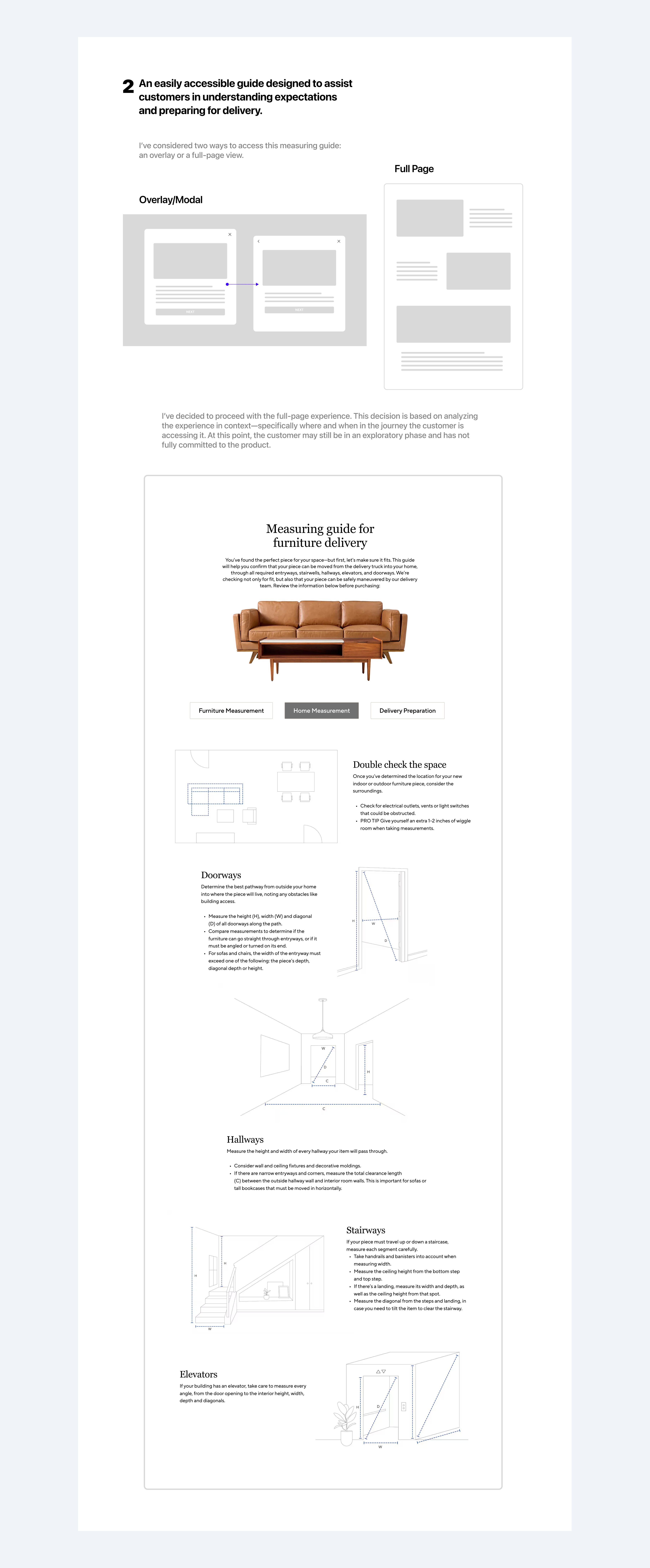
Creating the experience map helped us identify where the customer’s experience is well-supported and where it requires enhancement. We’re able to identify the overall themes of customer needs across these 4 focus areas of prioritization.
BUSINESS CONSTRAINTS
Pivot and Keep it Moving
During discovery with engineers and stakeholders, we ran into feasibility issues with our original plan. We wanted to use an overlay or modal notification in the shopping cart—where customers review items before checkout—because it’s the last chance to confirm custom-made items if the message was missed earlier. However, triggering this overlay from the checkout CTA conflicted with PayPal Checkout, as our contract prohibits us from interfering with their call to action.
Given this, I needed to find an alternative location that still leveraged the overlay, since it’s the most effective pattern and consistent with competitors. The next-best placement is on the product detail page, after the customer selects options and initiates adding the item to the cart. There, we can trigger the overlay before the add-to-cart action completes. The downside is potential drop-off: customers may pause to review the measuring guide and take action, then never return to finish the purchase.
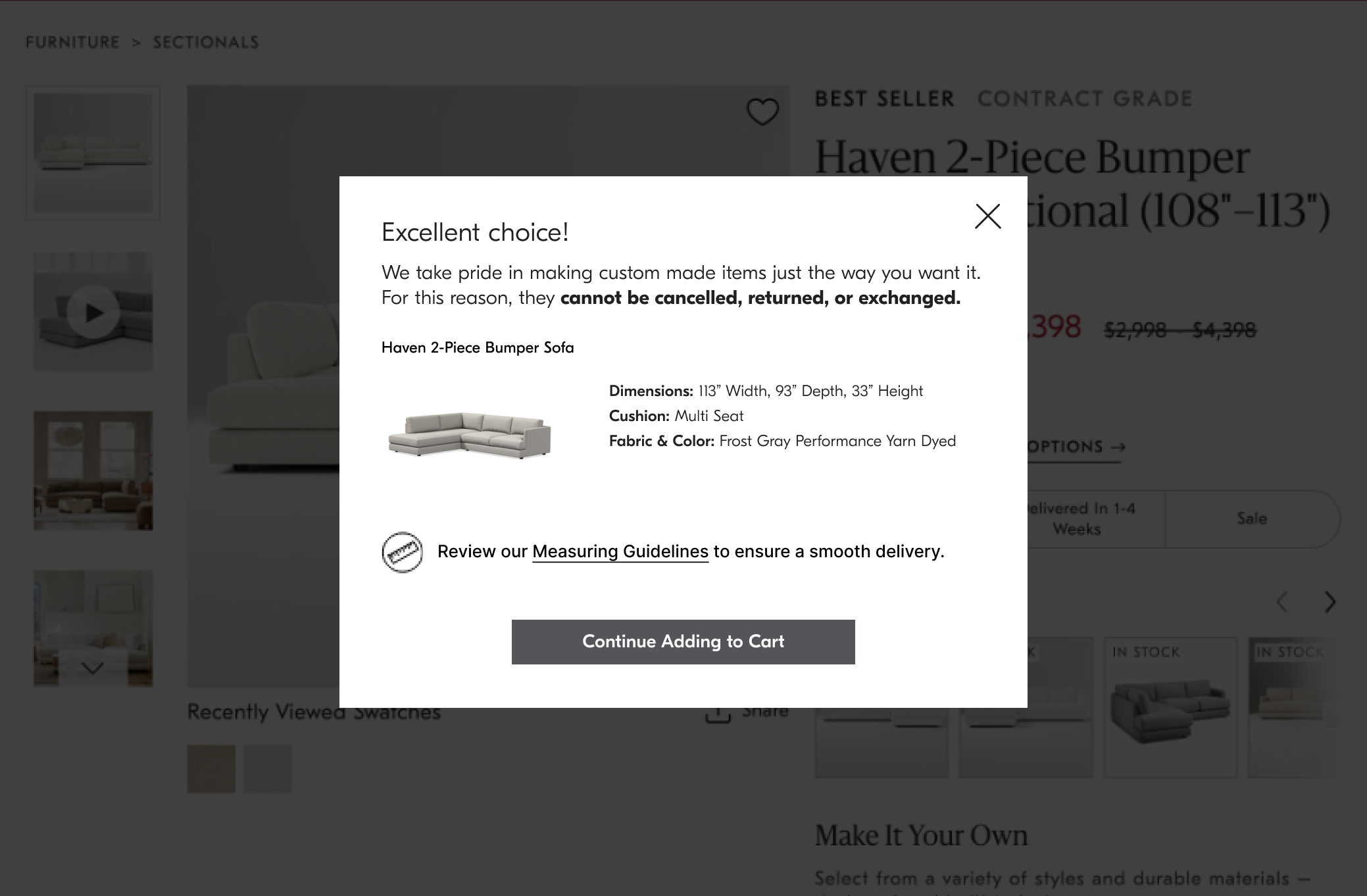
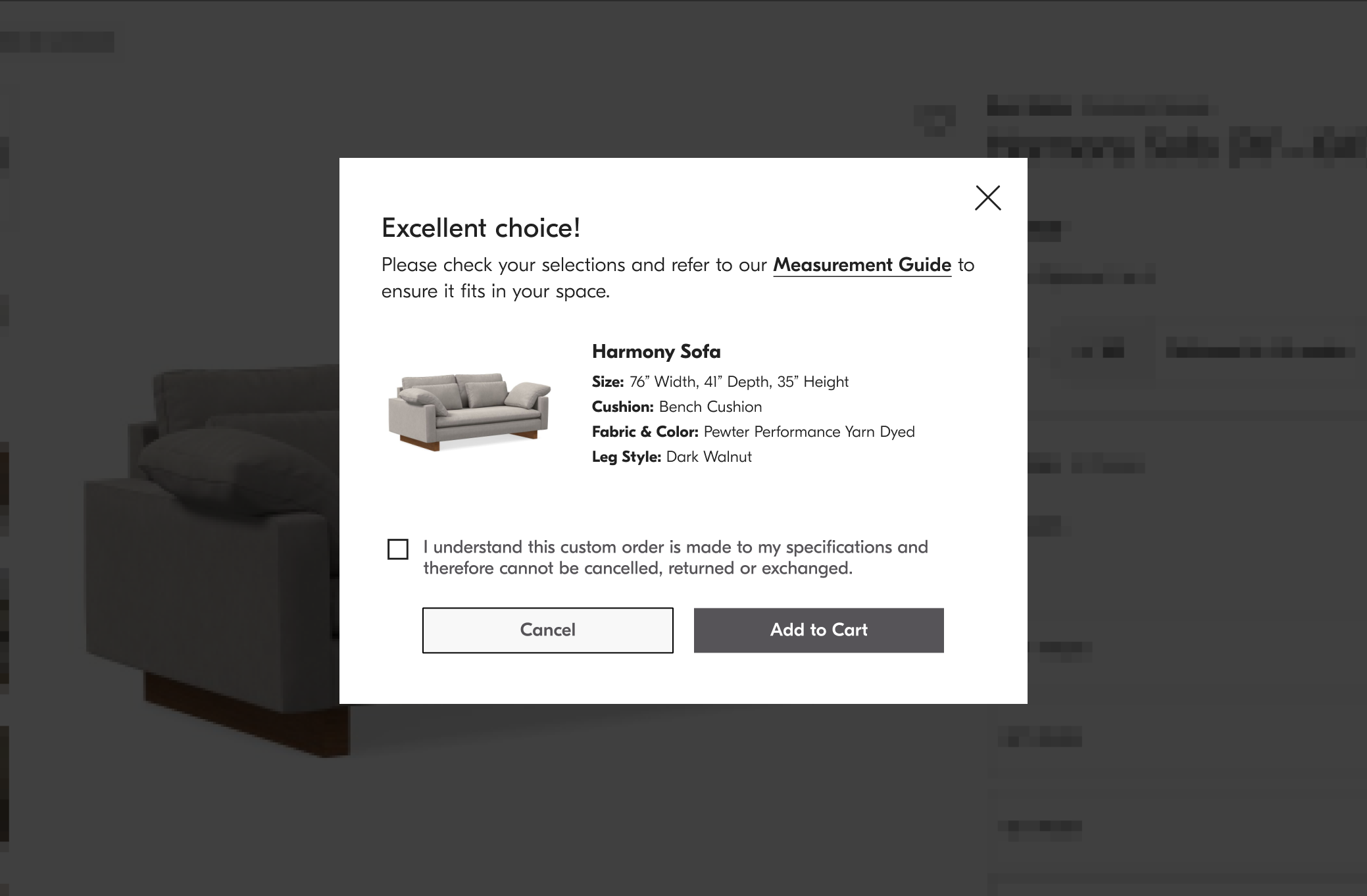
We decided to test this trade-off because the subtle reminders added to the product detail page months ago have already demonstrated impact, and this new addition is likely to be even more effective. I considered two options: a gentle reminder and a more assertive version that required checking a box for full compliance.
We chose the gentler version to reduce the risk of losing customers with a more demanding, commitment-heavy checkbox requirement.
EXPERIENCE ENHANCEMENTS
Through Iterative Releases
We launched and tested these areas of enhancements incrementally, starting with minimal effort, to learn from and build upon them.
We first added subtle reminders to the product detail page, targeting the areas where information gaps were most evident, and introduced a new measuring guide page to help customers measure and prepare for delivery. This combination proved highly effective, delivering positive results immediately.
Later, we shifted our strategy and introduced the overlay experience earlier in the funnel on the product detail page because of constraints. Although I initially worried this might be too much given the existing reminders, it ultimately proved beneficial and had an immediate positive effect.
Post-Launch Outcomes
- The measuring guide has experienced substantial page engagement, indicating that customers are locating it in the intentionally designated spots and making use of it.
- There has been a 5% reduction in returns due to product misinformation during our incremental launches in the first nine months, surpassing our 4% target.
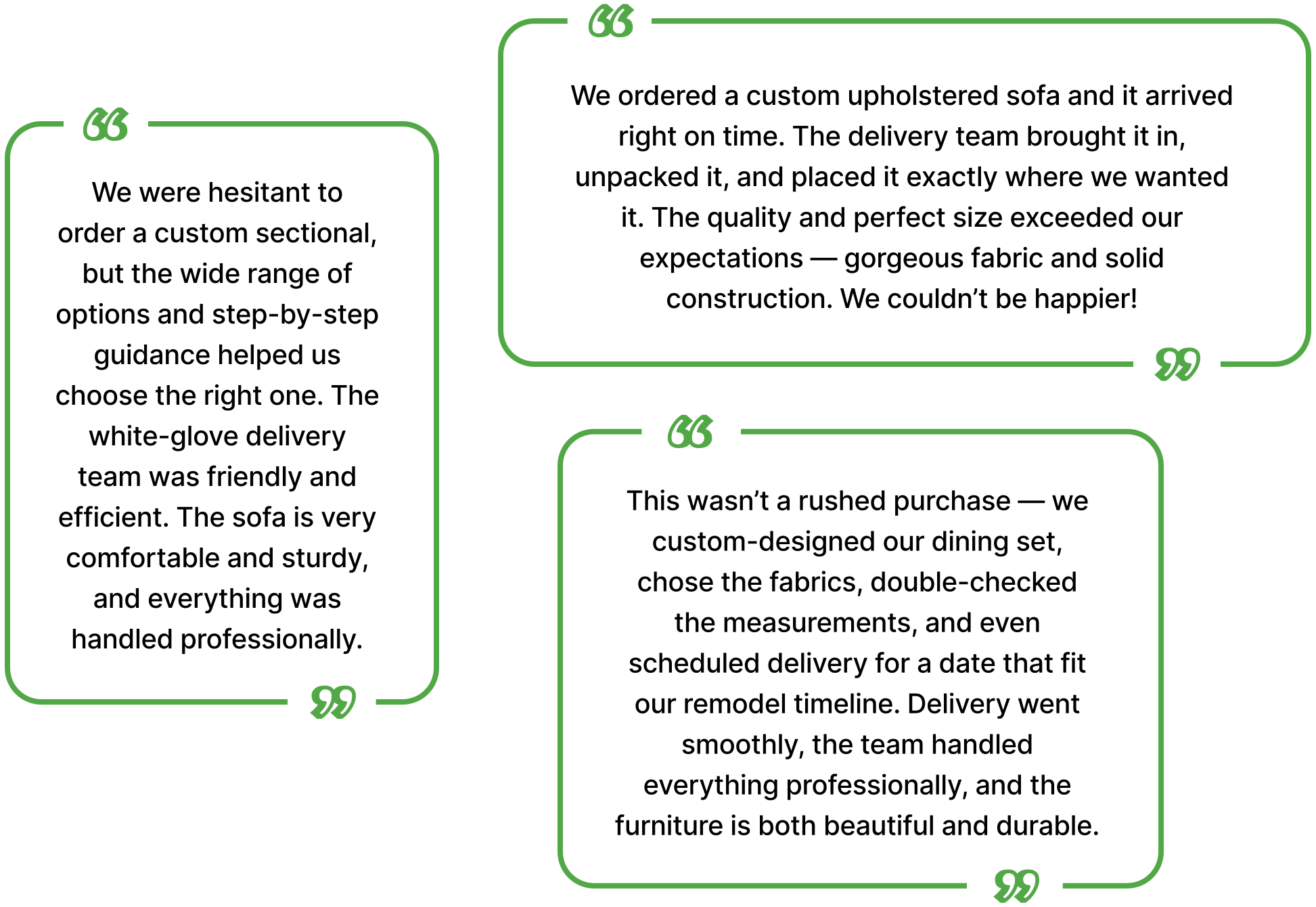
- An increase in the number of highly satisfied customers, as indicated by both our delivery partners and in brand approval.
DESIGN LEARNINGS
Continued Growth
This was one of my most rewarding projects because I personally experienced being a customer ordering a high-priced custom item and felt the challenge of ensuring the accuracy of my order.
Also, being assigned to a high-impact project shortly after joining the company added pressure. I had to immerse myself quickly and learn as much as I could by establishing a close working relationship with my partners in engineering and learning the capabilities and shortcomings of the platform we’re using.
Having the flexibility to adapt to any situation and avoiding attachment to a single solution is essential, since anything can happen. It's basically about not putting all your eggs in one basket, no matter how cliché it sounds.